

Collaborative Workforce Planning Module
Advanced employee scheduling software
The Challenges
As constraints multiply, every schedule becomes a balancing decision
Workforce planning must account for requirements, absences, availability, qualifications, rest periods and collective agreements.
When this information is scattered, managers spend more time reconstructing the situation.
Without the module
-
Requirements are consolidated manually
-
Availability remains scattered
-
Skills are verified separately
-
Rules are checked after the fact
-
Replacements require several exchanges
With the module
-
Requirements are entered or imported
-
Availability is brought together
-
Qualifications are taken into account
-
Rules structure the proposals
-
Exchanges follow a defined process
-
01
Turn demand forecasts into staffing requirements.
Import demand forecasts to inform staffing needs. Sigmia matches those requirements with available employees and scheduling constraints. For extensive requirements, forecasting tools can also be developed through a dedicated engagement.
-
02
Powerful calculations. Flexible rules.
Combine availability, skills, qualifications, seniority, rest periods and collective agreements. Configure rules and priorities by location and employee group, including the exceptions that matter to your operations.
-
03
Shift bidding governed by your rules.
Employees can bid on available shifts through a shift marketplace. Configured rules govern eligibility, assignment priorities and approvals, helping you allocate work consistently.
-
04
Simplify shift swaps. Keep your rules in place.
Employees can request shift swaps through self-service. Automated checks and approval workflows follow your configured rules, involving managers when required.
-
05
Schedules and requests, wherever work takes you.
Through the mobile app, employees can view schedules, submit availability and access permitted requests, shift bidding and shift swaps.
-
06
Plans change. Keep staffing on track.
Absences, availability changes and additional demand can require new assignments. Sigmia matches staffing needs with eligible employees to support replacements and schedule adjustments.
See constraints become a workable proposal
See how requirements, availability, skills, absences and rules are brought together.
Then see how managers review proposals, adjust assignments and approve schedules before they are shared with employees.
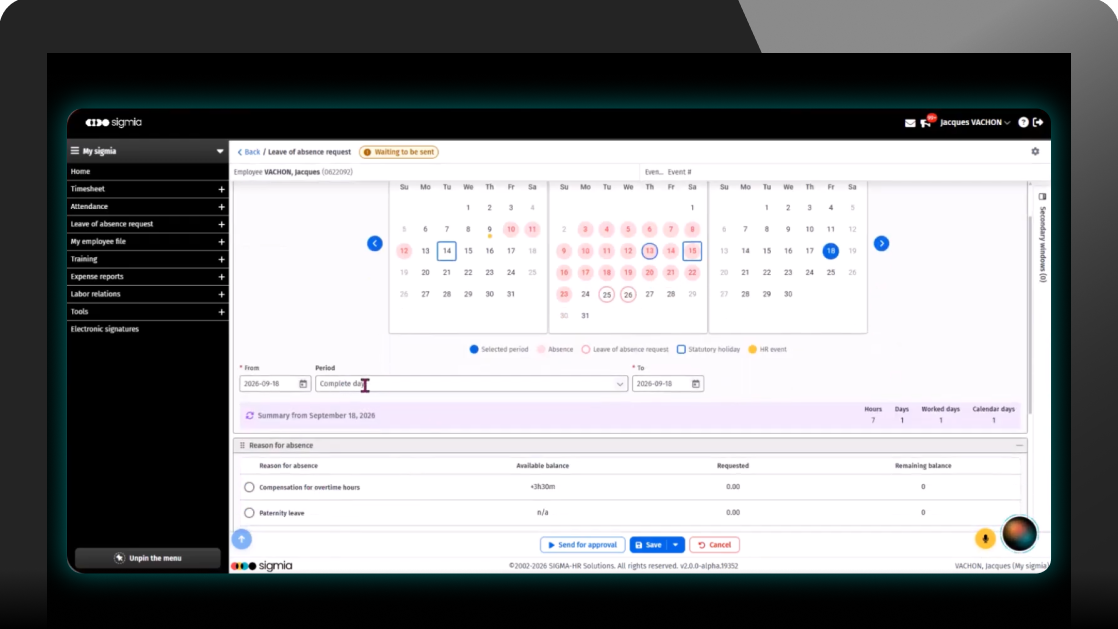
Constraint-based scheduling
Optimization algorithms built around your operational rules.
Scheduling uses constraint-based algorithms to combine staffing needs with configured rules. Managers can review proposals, adjust assignments and approve schedules.
Generative AI works separately to help users access information.


Scheduling in practice
Demanding operations. A proven solution.
-
01
Hundreds of stores. Scheduled every day.
A Canadian retailer with more than 5,000 employees uses Sigmia every day to schedule staff across hundreds of stores.
-
02
A Canadian-built solution, used in more than 20 countries.
The Sigmia solution is used in more than 20 countries. Its configurable rules support local time and scheduling requirements across locations and employee groups, based on an assessment of applicable rules and the configuration required.
-
03
Developed and supported in Canada.
Our teams help you assess scheduling requirements, configure work rules and adapt your processes as your organization evolves.
-
Time, Absence and Leave -
Time Capture and Scheduling -
Core HR
Frequently Asked Questions
Employee scheduling: your questions answered
Yes. Sigmia can import demand forecasts to inform staffing requirements. Scheduling then combines those requirements with availability, skills and organizational rules. Custom forecasting tools can also be developed for extensive requirements through a dedicated engagement.
Shift bidding allows employees to bid on available shifts through a shift marketplace. Configured rules determine eligibility, assignment priorities and required approvals.
Yes. Shift swaps can be subject to automated checks based on configured rules. The workflow also determines when a manager’s approval is required.
Employees can view schedules, submit availability and access permitted requests, shift bidding and shift swaps. Access rights and approvals follow the organization’s configuration.
Yes. Scheduling rules can be configured by location and employee group to account for different collective agreements and working conditions.
Yes. Configurable rule engines can accommodate different local requirements. The applicable scope is assessed and configured for the countries, locations and employee groups concerned. The Sigmia solution is used in more than 20 countries.
No. Sigmia does not offer continuous payroll calculation. Time management interprets hours and exceptions according to configured rules, then sends approved data to Sigmia’s Canadian payroll or a connected payroll system.