

Time Capture and Scheduling Module
Planned time meets actual time
The Challenges
When time capture is scattered, variances become difficult to explain
Schedules vary across employee populations, cycles, locations and collective agreements.
When data comes from multiple tools, teams must manually reconcile hours, breaks and exceptions.
Without the module
-
Hours come from several tools
-
Rules are applied manually
-
Variances are identified too late
-
Corrections lack traceability
-
Data must be consolidated
With the module
-
Capture channels are brought together
-
Rules are configured
-
Planned and actual time are compared
-
Anomalies are controlled
-
Approved data feeds payroll
-
01
Multichannel time capture
Capture hours from timesheets, time clocks, mobile devices or automated data flows.
-
02
Cycles and schedules
Interpret data according to applicable cycles, planned schedules and periods.
-
03
Breaks and work spans
Structure breaks, daily work spans and other defined parameters.
-
04
Overtime
Apply configured thresholds, premiums, multipliers and exceptions.
-
05
Planned and actual time
Compare planned schedules, reported hours and captured hours.
-
06
Controls and approvals
Have anomalies reviewed before data is used in HR and payroll processes.
See a captured hour become controlled data
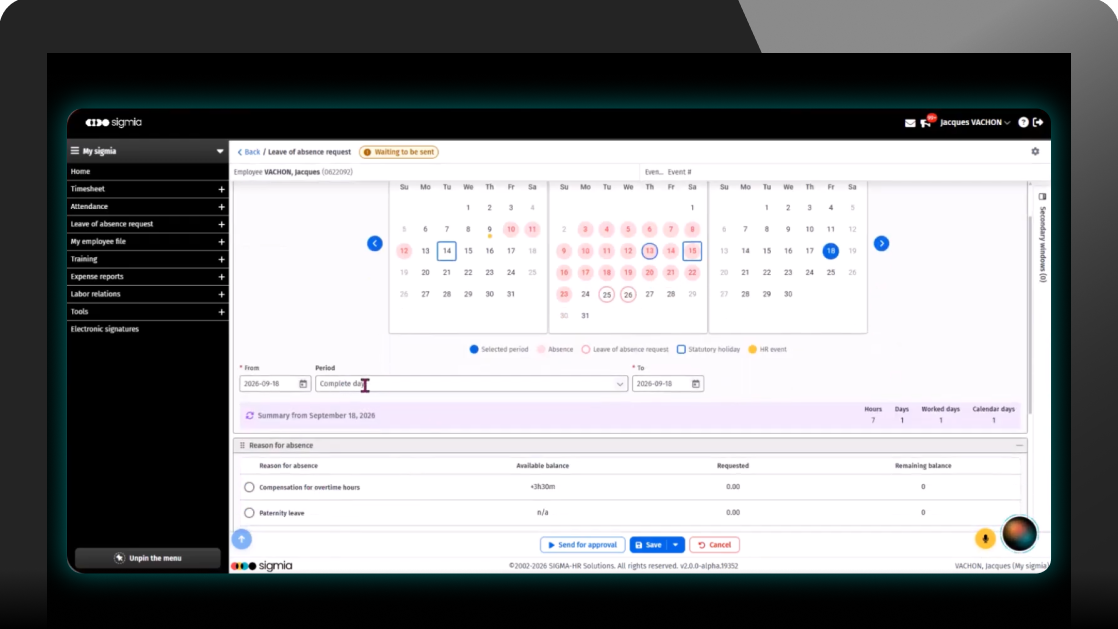
See how an hour is recorded through a time clock, timesheet or mobile device, then interpreted according to the applicable cycle.
Then see how managers identify variances, make the required corrections and submit the data for approval.
Integrated AI
AI improves access. Rules remain decisive.
Private and contextualized, Sigmia AI helps teams find and structure accessible information.
- Find a time-related situation
- Summarize available information
- Access contextual help
Calculations remain based on configured rules and human approvals.


-
Time, Absence and Leave -
Collaborative Workforce Planning -
Core HR
Frequently Asked Questions
Everything you need to know about time capture and work hour management
Hours can be captured through timesheets, physical or virtual time clocks, mobile devices or automated data flows.
It allows employees to record their hours through an authorized digital interface.
Access rights and controls are defined by the organization.
Thresholds, cycles, multipliers and exceptions can be configured according to business rules.
Results remain subject to the established controls.
Yes. Available schedules can be connected with reported and captured hours to identify variances.
Anomalies are presented to the people responsible so they can be reviewed, corrected or approved according to the defined process.
Yes. Approved hours and data can feed payroll processing according to implemented rules and interfaces.