

Grievances, Collective Agreements and Disciplinary Actions Module
Complete case files. Better-supported decisions.
The Challenges
When evidence is scattered, every case carries more risk
A labour relations case involves HR teams, managers, union representatives and advisors. When facts, clauses, documents and deadlines remain scattered, the organization must reconstruct the history before making a decision.
Without the module
-
Grievances are tracked by email
-
Clauses are searched manually
-
Actions are documented inconsistently
-
Deadlines lack visibility
-
Evidence must be reconstructed
With the module
-
Grievances follow a defined process
-
Clauses remain connected to each case
-
Actions follow a consistent framework
-
Deadlines and next steps are visible
-
The complete history remains accessible
-
01
Individual and group grievances
Bring the claim, facts, parties, cited clauses, responses and deadlines together in one case file.
-
02
Collective agreements
Document articles, versions, obligations and rules that apply to the relevant employee populations.
-
03
Letters of agreement and disputed clauses
Keep agreements, established interpretations and supporting documents connected to the applicable clauses.
-
04
Disciplinary and administrative actions
Structure events, meetings, documents, action types and applicable durations within a consistent framework.
-
05
Conciliation and arbitration
Track proceedings, hearings, commitments, decisions and case deadlines.
-
06
Notes, documents and history
Centralize working notes, evidence, communications and actions within a shared chronology.
See how a grievance becomes a defensible case file
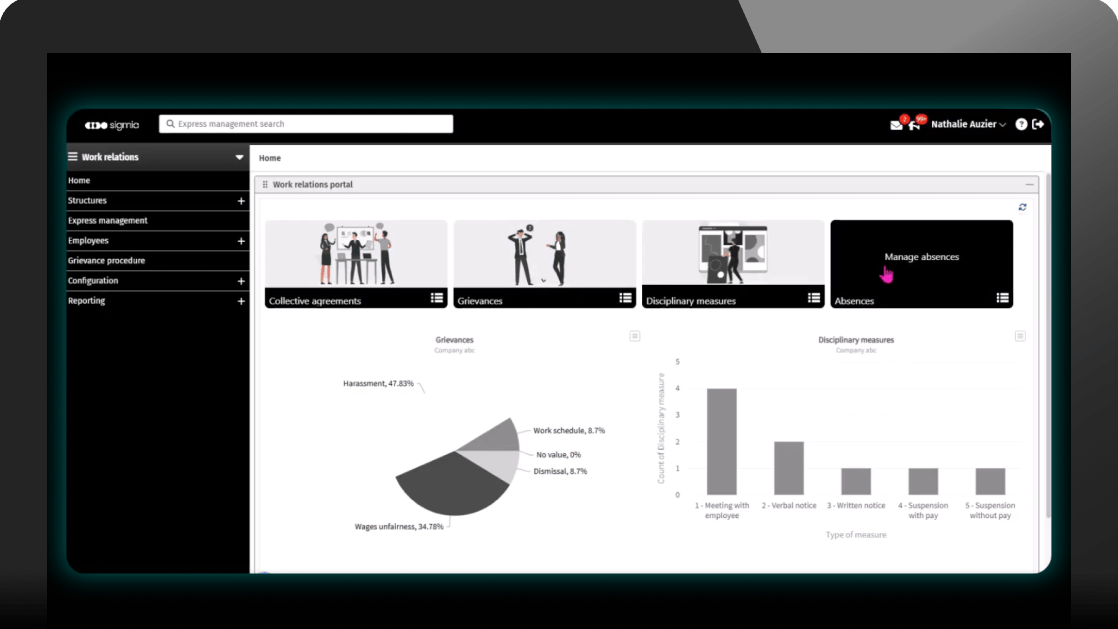
See how a grievance is recorded, connected to the applicable clauses and assigned to the responsible people. Then follow the responses, documents, deadlines, conciliation and arbitration process.
Integrated AI
AI finds the context. Your teams apply their judgment.
Private and contextualized, Sigmia AI helps authorized users find and structure the information they can access. The interpretation of facts, strategies and decisions remains the responsibility of your teams.
- Find a clause or case file
- Summarize an accessible case history
- Structure the chronology of events


It structures grievances, cited clauses, responses, documents, deadlines and resolution proceedings within a shared case file.
Yes. Categories, parties, responsibilities and stages can be configured according to the type of grievance and the applicable collective agreement.
Articles, versions, letters of agreement and interpretations can be documented and connected to the relevant case files.
Facts, meetings, documents, approvals, action types and durations remain grouped within a shared history.
Yes. It structures the stages, documents, deadlines, commitments and decisions. Strategies remain the responsibility of qualified professionals.
It draws on Core HR and can connect the case file with absence, time, payroll and other deployed processes.