

Occupational Health and Safety Challenges
When fragmented processes make every OHS case harder to manage
OHS operations involve multiple teams, sensitive documents, regulatory requirements and deadlines. Sigmia connects the information, responsibilities and actions required to make each process clearer and easier to govern.
-
01
Prevention efforts are difficult to coordinate
Bring risks, inspections, observations and corrective measures together to support more consistent practices across locations.
-
02
Incident records are spread across systems
Centralize reports, investigations, documents and decisions in a structured, chronological case file.
-
03
Medical information requires controlled access
Configure roles and permissions so users only access the information required for their responsibilities.
-
04
OHS cases are disconnected from absences
Transfer relevant information to absence or disability files to reduce duplicate entry and preserve continuity.
-
05
Regulatory deadlines are difficult to track
Structure alerts, supporting evidence and required actions so responsible teams can address each deadline.
-
06
Financial impacts remain difficult to interpret
Connect incidents, absences, cost allocations and assessments to better understand operational and financial impacts.


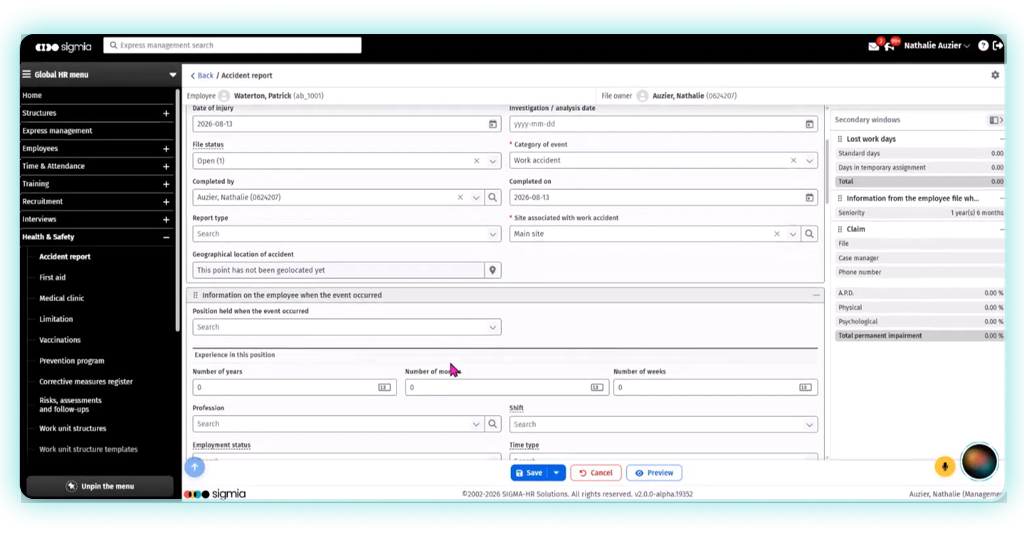
See the Occupational Health and Safety suite in action
Discover how Sigmia connects prevention, incidents, medical follow-ups, absences and WCB and CNESST case tracking in one environment.
Integrated AI
Private AI support where OHS teams need it
Sigmia’s AI works within the organization’s authorized data, documents, roles and configured rules. It can help users retrieve and summarize information or suggest a relevant next step. Every suggestion remains subject to review and approval by authorized employees.
- Find and summarize authorized information
- Identify potential missing steps or documents
- Support preventive and corrective action planning


-
Coordinate prevention activities
Connect risks, inspections and actions within shared processes.
-
Preserve complete case histories
Keep events, documents and decisions in chronological records.
-
Connect incidents and absences
Reduce duplicate entry and gaps between related processes.
-
Clarify every responsibility
Make required actions and deadlines visible to authorized teams.
-
Interpret financial impacts
Relate incidents and absences to allocations and assessments.
-
Support organization-wide oversight
Apply shared practices while maintaining local responsibilities.
Results for OHS and HR Teams
Fewer information gaps. Greater continuity across every case.
The suite gives OHS and HR teams a structured view of risks, incidents, responsibilities and deadlines. It helps preserve continuity from prevention through administrative and financial follow-up.
It is a group of five modules integrated into the Sigmia platform. The suite supports prevention, workplace injury and illness cases, medical follow-ups, vaccination and WCB and CNESST case tracking in a shared environment.
The suite includes Workplace Injuries and Occupational Illnesses, Prevention and Risk Management, Medical Clinics, Vaccination and CNESST Contributions (Quebec).
The modules can be deployed progressively and connected with other relevant Sigmia components according to organizational priorities. Deployment conditions must be confirmed during solution scoping.
Yes. Roles, permissions and selected processes can be configured according to locations, employee groups and responsibilities while supporting consolidated oversight.
Roles and permissions can be configured so each user accesses only the information required for their duties. Operations are recorded according to the organization’s governance rules.
The AI can search and structure authorized information and suggest verifications, documents or follow-up steps based on the available context. Authorized employees remain responsible for decisions and approvals.