

Time, Activities and Workforce Planning Suite
Time tracking and scheduling built for your workforce
Everyday schedules. Demanding rules. One flexible platform.
Developed and supported in Canada, Sigmia connects time tracking, absences and workforce scheduling. From everyday schedules to highly complex operations, configurable calculation engines apply your rules and collective agreements while giving employees more control over their schedules.
-
01
Absences are difficult to track
Centralize leave, disability cases, supporting documents, approvals, decisions and return-to-work follow-ups within structured processes.
-
02
Time collection is fragmented
Collect hours, breaks, delays and activities through timesheets, time clocks, badge readers, mobile devices or automated data flows.
-
03
Your work rules, down to the exceptions.
Interpret worked hours, breaks, premiums and overtime according to your policies and collective agreements. Configure calculations for different locations, employee groups and operational requirements.
-
04
Schedules aligned with operational demand.
Match staffing needs with availability, skills, seniority and applicable rules. Import demand forecasts to inform workforce requirements and adjust assignments as operations change.
-
05
Approved time data, ready for payroll.
Interpret hours and exceptions, apply your validation rules and send approved data to Sigmia’s Canadian payroll or your connected payroll system.
-
06
Give employees more control over their schedules.
Schedule access, availability, requests, shift bidding and shift swaps help employees participate in scheduling, within your configured rules and approval processes.


See the Time, Activities and Workforce Planning Suite in action
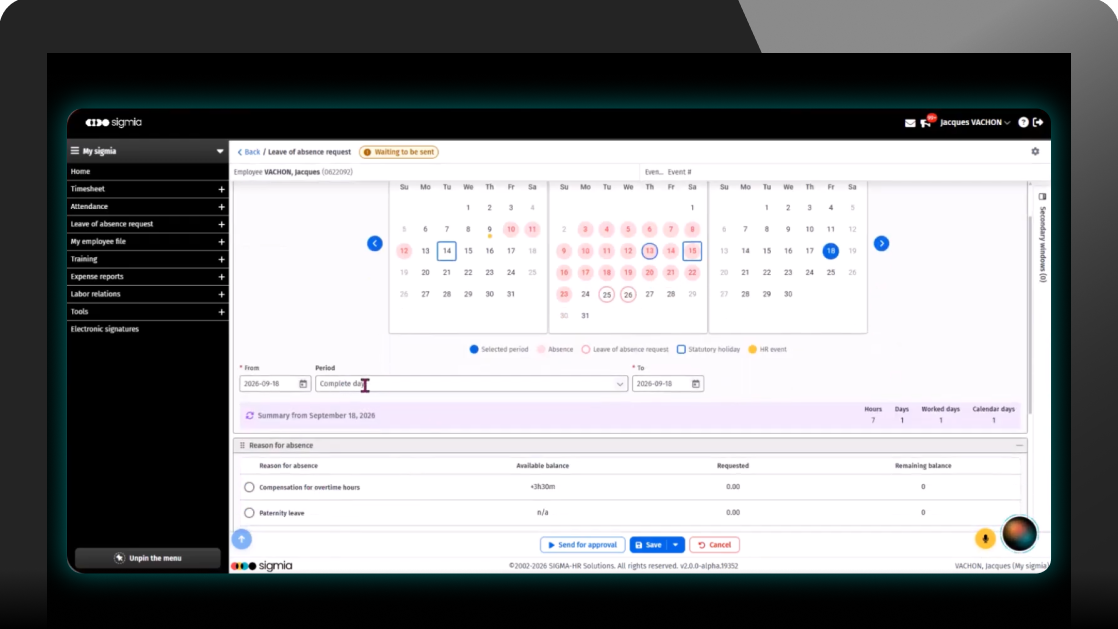
Follow an unexpected absence from the employee’s initial notification through availability updates, replacement planning, schedule adjustments, time collection and final validation. Connected information helps HR, managers, employees and payroll teams coordinate each stage from a shared operational record.
Integrated AI
Useful intelligence within clearly governed processes
Sigmia’s private, contextualized AI helps authorized users find, structure and summarize information. Scheduling remains based on constraint algorithms and human validation.
- Find relevant information more quickly
- Structure and summarize workforce information
- Preserve human review and decision-making


-
Reduce repeated data entry
Reuse approved absences, schedules and worked-time information across the processes that require it.
-
Standardize workforce processes
Apply structured requests, approvals, schedule reviews and time validations across employee populations.
-
Improve time-data quality
Compare planned, collected and approved time before information continues to Canadian payroll.
-
Increase employee involvement
Give employees access to leave requests, availability, schedules, shift exchanges and timesheets.
-
Apply rules consistently
Use configured schedules, breaks, premiums, rest periods, collective agreements and documented exceptions.
-
Improve operational visibility
Give HR, managers and payroll teams a clearer view of absences, replacements and variances.
What your teams gain
Fewer information gaps. Greater operational continuity.
When the modules are connected, absences, availability, schedules and worked time can move through a more coherent operational flow. HR teams and managers gain clearer information for replacements and approvals. Employees receive direct access to their requests and schedules. Validated time data can continue to Sigmia Canadian Payroll or another connected payroll system.
The suite currently includes Absence and Leave Management, Time and Activity Collection and Collaborative Intelligent Scheduling. Each module can be deployed independently or connected to the others according to the organization’s priorities, processes and technology environment.
Yes. Sigmia modules can be deployed according to the organization’s needs. When combined, they connect absences, planned schedules, availability and actual time within the same Sigmia environment.
Employee time can be collected through timesheets, physical or virtual time clocks, mobile devices or automated data flows. The platform then interprets the data according to configured cycles, schedules, breaks, overtime rules and business requirements.
Staffing requirements can be entered or informed by imported demand forecasts, then matched with availability, skills, qualifications, seniority, absences and applicable rules. Constraint-based algorithms produce schedule proposals that managers can review, adjust and approve.
No. Workforce schedules are produced using constraint-based algorithms, not generative AI. This supports stable, repeatable and verifiable application of organizational rules, while managers retain control over final assignments and approvals.
Yes. Approved time, absences and related data can feed Sigmia’s Canadian payroll or a connected payroll system, according to the configured controls and interfaces. Sigmia does not offer continuous payroll calculation.