

The Challenges
When data is scattered, changes become difficult to explain
Assessments are based on insurable payroll, classification units, injuries and the applicable assessment method. Without continuity between cases, teams must reconstruct the source of each variance.
Without the module
-
Data is distributed across multiple files
-
Injuries are analyzed separately
-
Costs are reconciled manually
-
Scenarios lack continuity
-
Decisions are difficult to document
With the module
-
Data is connected to OHS cases
-
Units are grouped together
-
Costs remain associated with injuries
-
Scenarios are documented
-
Analyses retain their history
-
01
Units and classification
Bring together classification units, locations and the data required for follow-up.
-
02
Assessment methods
Structure analyses according to the unit rate, personalized rate or retrospective assessment method.
-
03
Injury costs
Connect cases with benefits, absences and other available costs.
-
04
Cost allocations and decisions
Track information related to injuries, decisions, transfers and disputes.
-
05
Projections and scenarios
Compare different assumptions to better understand how assessments may evolve.
-
06
Retrospective adjustments
Document calculations, deadlines and the information required to track adjustments.
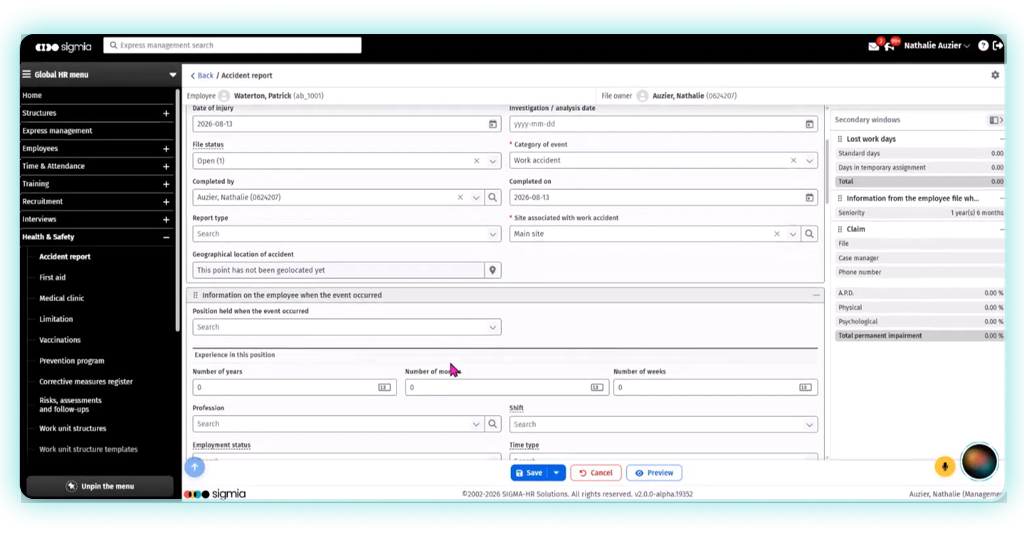
See an injury become a financial analysis
See how cases, costs and units are connected. Then follow the assessment method analysis, scenario preparation and decision tracking.
Integrated AI
AI identifies variances. Your teams validate the analysis.
Private and contextualized, Sigmia AI helps authorized users find, extract and summarize accessible data. Assumptions and decisions remain their responsibility.
- Summarize the information associated with an injury
- Identify a change or variance
- Compare data from multiple scenarios
-
Workplace Injuries and Occupational Diseases -
Prevention and Risk Management -
Occupational Health Clinics -
Vaccination
It brings together units, injuries, costs, assessment methods, scenarios and adjustments associated with CNESST assessments.
The module can support the analysis of personalized rates and retrospective assessments.
Costs, absences, decisions and other available information can be connected with the relevant OHS case.
It performs calculation simulations, analyses and scenarios. The CNESST remains responsible for the official rate and assessment.
Yes. Different assumptions can be compared to better understand how costs and assessments may evolve.
No. It helps bring together data, supporting documentation and deadlines. The decision remains the responsibility of qualified individuals.