
On any given morning, a national talent acquisition team might be reviewing applications for a supervisor in Toronto, an analyst in Vancouver and a manager in Calgary. The recruiters work with the same applicant tracking system, follow similar procedures and use the same technology to identify candidates whose qualifications appear to match the requirements of each position. From an operational perspective, the organization has achieved something valuable: a consistent approach to recruitment across its locations.
Yet behind that consistency lies a more complicated reality. The Toronto job posting may require a statement disclosing the use of artificial intelligence, while the Vancouver and Calgary recruitment processes are subject to different provincial privacy provisions. If the organization operates in a federally regulated industry, another legal framework may come into play. The technology can be standardized across the country, but the responsibilities associated with its use cannot always be.
This fictional scenario illustrates an increasingly important challenge for Canadian HR leaders. Artificial intelligence offers opportunities to reduce administrative work, identify relevant qualifications and help recruiters manage large volumes of applications. At the same time, it introduces new considerations about how candidate information is interpreted, where that information travels and how much influence technology has over access to employment.
As organizations explore these possibilities, the conversation needs to move beyond whether AI should be used in recruitment. What matters increasingly is whether employers understand the role it plays in their decisions.
Ontario’s AI disclosure requirements are only the beginning
Since January 1, 2026, Ontario’s Employment Standards Act has required covered employers to disclose the use of artificial intelligence in qualifying publicly advertised job postings when AI is used to screen, assess or select applicants. The requirement applies to employers with at least 25 employees in Ontario on the day the posting is published, counting individuals rather than full-time equivalents. Related-employer provisions may also be relevant. The Act generally governs provincially regulated employment, rather than federally regulated employment in industries such as banking or aviation.
For a national organization, this introduces a responsibility that extends beyond the team preparing the job advertisement. The person approving the posting needs to understand how applications will subsequently be processed, including which technologies will be used and whether an external recruitment agency will be involved. According to the Government of Ontario’s guidance on publicly advertised job postings, employers remain responsible for meeting applicable requirements when third parties recruit on their behalf.
The scope of the legislation is also important. Under Ontario Regulation 476/24, internal-only postings, general recruitment campaigns and help-wanted signs that do not advertise a specific position are excluded. So are positions based entirely outside Ontario and certain positions involving work both inside and outside the province, where the out-of-province work is not a continuation of the work in Ontario. The Crown, Crown agencies and bodies whose members are all appointed by the Crown are also exempt. Employers therefore need to consider both the nature of the position and the actual recruitment process before determining whether disclosure is required.
Consider the difference between a recruiter using generative AI to improve the wording of a job advertisement and another using it to assess applicants’ qualifications. Both are using artificial intelligence, but the first activity alone does not establish that AI is being used in candidate selection. The distinction can become less obvious when information generated during the preparation of a job description subsequently feeds into automated matching or ranking. Understanding how these functions interact is more useful than simply knowing whether the software contains AI.
Where an organization uses AI to screen and assess applications, a disclosure might read: “We use artificial intelligence to help screen and assess applications for this position.” Ontario does not prescribe that exact wording or require employers to provide a technical explanation of the algorithm in the posting. The statement should, however, accurately reflect the activities taking place.
There is an important distinction between informing candidates that AI is being used and understanding whether it is being used responsibly. A disclosure statement tells applicants something about the recruitment process, but it says little about the relevance of the selection criteria, the protection of their personal information or the ability of a recruiter to challenge a recommendation. Those questions deserve at least as much attention as the wording of the advertisement itself. We cover how AI can support the writing of job postings in our article on writing effective job postings with AI.
One recruitment platform, several legal realities
For organizations operating across Canada, standardizing HR technology can bring considerable operational benefits. Common processes make it easier to coordinate recruitment activities, maintain consistent reporting and give HR leaders a clearer understanding of workforce needs. However, Canada’s regulatory landscape requires employers to distinguish between the efficiencies of a shared technological environment and the legal obligations associated with individual recruitment activities.
Canada does not have a single general private-sector AI hiring law applying uniformly to every employer. As the Office of the Privacy Commissioner of Canada explains, privacy obligations depend on the nature of the organization, its activities and the jurisdiction in which it operates.
That landscape may also change. Bill C-36, introduced in the House of Commons on June 15, 2026, proposes replacing Part 1 of PIPEDA with the Protecting Privacy and Consumer Data Act. Among other changes, it would establish transparency obligations for automated predictions, recommendations or decisions that could have a legal or comparably significant impact on individuals. Under the proposal, individuals could ask for an explanation and submit written observations to an employee able to review the outcome. These proposed protections are not limited to fully automated decisions. As of November 2026, the bill remains before Parliament and has not become law.
For federally regulated businesses, such as banks and airlines, the Personal Information Protection and Electronic Documents Act (PIPEDA) expressly covers personal information concerning applicants for employment. Under section 7.3 of PIPEDA, certain employment-related information may be collected, used or disclosed without consent when necessary to establish, manage or terminate an employment relationship, provided the individual has been appropriately informed. This exception does not authorize unrestricted collection or the subsequent use of applicant information for unrelated purposes.
Ontario, meanwhile, has no general private-sector employment privacy statute equivalent to those in British Columbia, Alberta and Québec. This does not leave candidate information without protection: human rights law, sector-specific requirements, privacy obligations related to particular commercial activities and other legal duties may still apply.
In British Columbia and Alberta, provincial privacy laws establish conditions under which employers may collect, use and disclose personal information for recruitment without consent. The rules differ, including in their notification requirements. Employers operating in both provinces should therefore verify the conditions applicable to their recruitment practices rather than assume that the same procedures are sufficient.
Québec presents another distinct regulatory environment. Under section 12.1 of its private-sector privacy legislation, amended by Law 25, an enterprise must notify an individual when a decision concerning them is based exclusively on automated processing of their personal information, at the latest when the decision is communicated. The individual may ask what information was used, what reasons and main factors or parameters led to the outcome, and what right they have to correct the information used. They must also be able to submit observations to a staff member capable of reviewing the decision. In recruitment, these protections can become particularly relevant when an automated system rejects applicants without human involvement.
Québec’s legislation also requires a privacy impact assessment for projects to acquire, develop or overhaul an information system or electronic service delivery system involving personal information, under section 3.3. Introducing an AI-enabled recruitment platform may therefore require more than a review of its functionality: the organization needs to consider the implications for candidate information from the outset.
These differences do not mean that a national employer needs a separate recruitment platform for every province. They do mean that HR and IT leaders need sufficient visibility into their systems to understand which features are being used, how recruitment workflows are configured and whether particular locations or employing entities require different controls. A consistent experience for recruiters should not come at the expense of the organization’s ability to account for its responsibilities.
A résumé contains more information than a recruiter needs
Much of the conversation about AI in recruitment focuses on how effectively technology can identify promising candidates. Less attention is sometimes given to the information the technology needs to accomplish that task.
A résumé is an unusually rich collection of personal information. Alongside professional experience, qualifications and technical competencies, it may contain a home address, personal contact details, membership in professional associations or information that indirectly reveals aspects of an individual’s personal circumstances. While some of these details may be relevant to a particular position, others contribute little to understanding whether the person can perform the work.
Artificial intelligence changes what organizations can do with that information. Details that once appeared incidentally in a document can become searchable, comparable and available for analysis across hundreds or thousands of applications. A technology introduced to identify relevant qualifications may also make it easier to process information that was never necessary for evaluating them.
This is why privacy considerations need to begin with the purpose of recruitment rather than the capabilities of the software. The fact that a candidate voluntarily provides information does not mean every detail should influence their assessment. Similarly, an employment-related exception to consent does not automatically justify collecting unnecessary information or repurposing it for other activities.
Under PIPEDA’s accountability and information-handling principles, where the legislation applies, organizations remain responsible for personal information transferred to third parties for processing and must establish appropriate protections. The distinction becomes particularly important when an AI provider proposes using applicant information not only to deliver recruitment services, but also to improve its models or develop other products. Those additional purposes require their own assessment.
For HR leaders, the opportunity is to reconsider the relationship between the amount of information an organization collects and the quality of the decisions it makes. Having more information does not necessarily lead to better recruitment. The more useful ambition is to identify which information genuinely helps assess a candidate’s ability to succeed in a role and ensure that it can be used within an appropriately governed environment. We explore how to structure candidate information in our article on optimizing candidate profiles with AI.
When candidate information leaves the recruitment environment
The emergence of general-purpose AI assistants adds another dimension to the protection of candidate information. A recruiter no longer needs a dedicated recruitment application to summarize a résumé, compare qualifications or prepare interview questions. These activities can also be performed through conversational AI tools, sometimes independently of the organization’s established recruitment systems.
Consider a recruiter who copies several résumés into ChatGPT or Claude to prepare an initial comparison. The task may take only a few minutes and produce a useful summary. From the recruiter’s perspective, AI has removed a repetitive administrative step. From the organization’s perspective, however, another environment may now be involved in processing confidential personal information, with its own arrangements for access, retention and potential reuse.
The same considerations arise when organizations connect external AI assistants directly to their human capital management (HCM) systems. A connector may respect the permissions established within the original platform, but those permissions do not necessarily explain what happens to information once it has been retrieved. Depending on the service and its configuration, candidate information, prompts and generated responses may be processed or retained in conversation histories, technical logs or other environments.
As we explore in our article on connecting Claude or ChatGPT to your HCM system, understanding the conditions under which an AI assistant accesses information is only part of the governance challenge. Organizations also need visibility into what happens to that information throughout its lifecycle.
This does not mean that external AI services are inherently unsuitable for recruitment. Enterprise offerings governed by contractual agreements can provide conditions and protections that differ considerably from those associated with personal accounts. What matters is the organization’s ability to evaluate the specific service, understand the information being transmitted and determine whether the arrangements meet its applicable privacy and security obligations.
Privacy and security are not the only considerations. Employers should also examine the service provider’s contractual terms and acceptable-use policies. For example, OpenAI’s usage policies restrict the automation of consequential employment actions without human review. Other providers may impose their own conditions. An enterprise subscription does not, on its own, establish that a particular recruitment use is permitted.
Location is one part of that assessment. Alberta has specific requirements concerning certain uses of service providers outside Canada, while Québec’s section 17 requires a privacy impact assessment before covered transfers of personal information outside the province, including relevant outsourcing arrangements. Transfers subject to that provision require adequate protection and a written agreement reflecting the assessment. Neither framework should be read as a blanket ban on processing information abroad. Employers may also need to consider who can access information remotely, which subcontractors are involved, whether data can be reused to improve AI models and how records are deleted when they are no longer required.
For organizations investing in integrated HR environments, there is a broader strategic consideration. Every additional application that processes candidate information can introduce another environment to govern. As AI becomes more accessible, maintaining visibility into those environments may become just as important as ensuring that recruiters have access to the tools they need.
A consistent hiring process is not necessarily a fair one
One of the appealing characteristics of automated recruitment is its ability to apply the same criteria across a large number of applications. Consistency can support more structured assessments and reduce some forms of variability associated with manual screening. But consistency should not be confused with fairness.
Imagine an organization that gives greater weight to candidates with uninterrupted employment histories. An automated system could apply that criterion with considerable precision, consistently ranking those applicants above people who have taken extended career breaks. Yet an interruption in someone’s employment history may reflect caregiving responsibilities, disability-related needs, further education or a professional transition. Depending on the circumstances, the criterion could disadvantage certain individuals without providing a more reliable indication of their ability to perform the job.
The problem in this situation does not necessarily originate in the technology. It may originate in the organization’s understanding of what a strong candidate looks like. Artificial intelligence gives that understanding greater reach, turning assumptions that might previously have influenced individual hiring decisions into criteria applied systematically across thousands of applications.
Canadian human rights legislation, including the Canadian Human Rights Act within federal jurisdiction and the corresponding provincial frameworks, continues to apply regardless of whether employers use AI or conventional recruitment methods. The introduction of technology does not remove the responsibility to consider whether selection criteria are job-related, whether they create discriminatory effects and whether accommodation is required.
Ontario’s privacy and human rights commissioners have recognized the importance of these considerations through their joint principles for the responsible use of artificial intelligence, published in January 2026. Although the principles were developed in a public-sector context, they offer useful guidance to private-sector organizations and are not, in themselves, binding private-sector regulations. The Ontario Human Rights Commission’s Human Rights AI Impact Assessment also provides organizations with a framework for examining potential human rights implications associated with AI systems.
These resources offer an opportunity for HR leaders to revisit established recruitment practices before embedding them more deeply into technology. A system that accurately applies an unsuitable criterion is unlikely to improve the quality of recruitment, regardless of how efficiently it processes applications.
Accessibility begins long before an interview
The relationship between technology and fairness becomes particularly apparent when considering how candidates demonstrate their abilities. A timed video assessment, for example, may be designed to evaluate communication or problem-solving skills. For a person whose disability affects how they interact with the technology, however, the assessment format itself could become a barrier unrelated to the competencies the employer is trying to measure.
An accessible recruitment process requires more than a statement about inclusion. Candidates need a meaningful way to request accommodation, and employers need procedures that allow an alternative assessment to be considered when appropriate. Applicable human rights legislation may require accommodation up to the point of undue hardship, as explained in the Alberta Human Rights Commission’s guidance on the duty to accommodate.
Ontario’s accessibility regulation also establishes specific recruitment requirements. Covered employers must publicize the availability of disability-related accommodation and notify applicants individually selected for an assessment or selection process that accommodation is available upon request. If a selected applicant requests it, the employer must consult with the applicant and provide or arrange suitable accommodation that takes their accessibility needs into account.
Accessibility Standards Canada has also published CAN-ASC-6.2:2025, Accessible and Equitable Artificial Intelligence Systems. This voluntary standard provides further guidance on accessibility, equitable treatment and the governance of AI systems. Together with human rights impact assessment resources, it can help employers evaluate technologies more thoughtfully, although these resources should not be interpreted as imposing a universal statutory AI audit requirement on every Canadian business.
Organizations may also benefit from examining patterns in recruitment outcomes, where lawful and proportionate, to identify potential barriers. Collecting sensitive demographic information for that purpose introduces its own privacy considerations. For HR leaders, the objective should be to ensure that recruitment technology helps identify people capable of performing the work, rather than simply identifying those best equipped to navigate the assessment process.
Human oversight depends on the ability to intervene
Imagine that an applicant holds a professional licence required for a position, but the information is not correctly extracted from their résumé. The recruitment system subsequently assigns the candidate a lower ranking, and the recruiter, faced with hundreds of applications, concentrates on the profiles appearing at the top of the list. No one has necessarily decided that the applicant is unqualified. The relevant information has simply failed to reach the person responsible for making that assessment.
This is an important distinction because the influence of AI on recruitment is not confined to the final hiring decision. Technology can shape which information receives attention, which candidates are considered and which profiles progress far enough to benefit from human judgment.
Organizations frequently emphasize that their recruitment processes retain a human decision-maker. But the value of that safeguard depends on the conditions under which the person exercises their judgment. A recruiter needs access to the original information, an understanding of what the system’s recommendation represents and the authority to correct an error or reconsider a result. They also need sufficient time to do so.
These considerations are particularly important in organizations recruiting at scale. If a recurring extraction error causes several qualified candidates to be overlooked, correcting a single profile may address the immediate problem without resolving the underlying issue. The recruitment team needs a way to communicate the anomaly to the people responsible for configuring and maintaining the system, so that the organization can determine whether other applications have been affected.
This is where AI governance in HR becomes an organizational responsibility rather than simply a technological feature. Meaningful oversight requires clearly defined roles, appropriate access permissions, escalation procedures and the ability to respond when evidence challenges the system’s recommendations.
At Sigmia, this approach to oversight also shapes how we integrate AI into recruitment. Rather than replacing the recruiter’s assessment, AI can help structure some of the information that informs it. When enabled and configured, it can analyze CVs from external candidates and identify skills that correspond with the organization’s competency framework. Recruiters can return to the original CV to verify the information and determine whether the skills identified accurately reflect the candidate’s experience.
Recruiters can then use this information alongside tools for comparing candidate qualifications with job requirements. The aim is to give HR professionals useful information for their assessment while keeping validation, interpretation and recruitment decisions under human responsibility.
What happens when a candidate questions a decision?
As recruitment becomes increasingly supported by technology, employers also need to consider how they would respond to someone questioning the outcome of an application. A candidate may believe that important qualifications were overlooked, that information used to assess them was inaccurate or that the format of an assessment prevented them from demonstrating their abilities. The organization’s ability to respond depends in part on whether it understands how the decision was reached.
Ontario’s AI disclosure requirement does not, by itself, create a general right for every unsuccessful applicant to demand a human review of an automated ranking. Québec’s private-sector privacy legislation, however, establishes specific protections for exclusively automated decisions. Applicable privacy rights of access and correction, human rights protections and jurisdiction-specific automated decision-making requirements must therefore be examined separately.
The federal public service offers a useful illustration of a more structured approach. Within the applicable scope of the federal Directive on Automated Decision-Making, systems supporting or recommending administrative staffing decisions can trigger requirements even when the final decision is made by a person. The Public Service Commission of Canada’s guidance on AI in hiring addresses algorithmic impact assessments, candidate notification, meaningful explanations and opportunities for recourse.
These requirements have a defined public-sector scope and do not automatically apply to private-sector recruitment. Nevertheless, they raise considerations relevant to any organization introducing AI into its hiring processes. If a candidate points out that an important qualification was misinterpreted, can the organization retrieve the original information, understand the assessment and determine whether the application deserves another look?
The answer will depend not only on the available technology but also on the responsibilities established around it. An internal review procedure has limited value if the person receiving the request cannot access the relevant information or change the outcome. Organizations that anticipate these situations during the design of their recruitment processes are better positioned to investigate problems when they arise.
What HR leaders should be asking before adopting AI recruitment tools
Technology demonstrations tend to focus on what a system does well: the speed with which it processes applications, the relevance of the profiles it identifies and the administrative effort it can potentially remove. For HR leaders, it may be equally revealing to examine how the technology responds when information is incomplete, a candidate’s career path is unconventional or a recommendation appears questionable.
These situations provide a more comprehensive understanding of how an AI-enabled recruitment system might operate within the organization. They also create an opportunity for HR, IT, legal, privacy and accessibility teams to establish shared expectations before a solution is purchased or a new feature is activated.
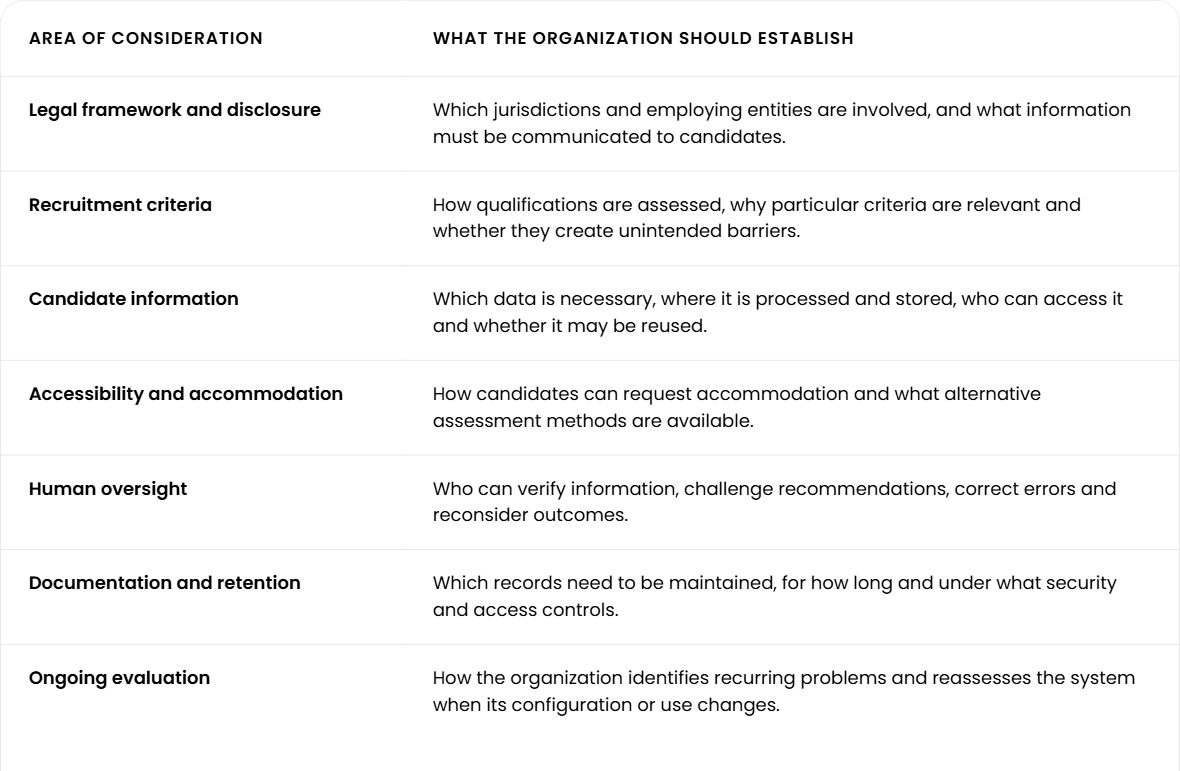
For HR leaders, assessing an AI recruitment solution involves three distinct but interconnected responsibilities. The first concerns legal obligations: what employment, privacy, human rights and accessibility legislation requires of the organization. The second concerns the contractual conditions under which the technology operates, including how providers process candidate information and whether their terms permit the intended use.
The third extends beyond compliance. It concerns the organization’s ability to understand, evaluate and maintain control over the technology it uses. Meaningful human oversight, the ability to trace and reconsider recommendations, and the ongoing evaluation of recruitment practices all contribute to responsible governance. Some of these safeguards may also be legally required, depending on the jurisdiction and circumstances.
A recruitment solution should therefore be evaluated not only on what it enables an organization to accomplish, but also on how effectively it allows the organization to exercise its responsibilities.
Recordkeeping illustrates why that distinction matters. In Ontario, covered employers must retain copies of publicly advertised job postings and associated application forms for three years after public access ends, as outlined in the province’s employment standards guidance. Information that covered employers must communicate to interviewed applicants about whether a hiring decision has been made must also be retained for three years after it is provided. British Columbia, by contrast, generally requires personal information used to make a decision directly affecting an individual to be kept for at least one year after its use under section 35 of its privacy legislation. Neither provision establishes a uniform national retention period for every résumé or AI-generated assessment.
The same attention to context should inform discussions with technology providers. Rather than relying on a general statement about compliance, organizations should seek clear explanations of how candidate information is handled, what determines a recommendation and which controls are available. Where possible, those explanations should be tested against the system as it will actually be configured and used.
A different measure of recruitment effectiveness
For years, recruitment technology has been evaluated through familiar indicators: time to hire, cost per hire, application volumes and the administrative effort required to fill a position. Artificial intelligence offers opportunities to improve many of these measures, particularly for organizations managing significant recruitment needs. But its growing influence on how candidates are identified and assessed suggests that another set of considerations deserves attention.
How easily can a recruiter verify the information behind a recommendation? How effectively can an organization identify qualified candidates whose experience does not follow a conventional career path? Can HR leaders explain why particular selection criteria are used, and can they change those criteria when the evidence suggests they are no longer serving their intended purpose?
These considerations connect the quality of recruitment directly to the broader responsibilities of the HR function. They position HR leaders not simply as users of technology, but as the people who help determine how that technology shapes access to employment, protects personal information and supports organizational decisions.
Returning to our national employer, the Toronto, Vancouver and Calgary recruitment teams can all benefit from a common technological environment. The value of that environment lies in its ability to accommodate different operational realities and legal obligations while giving the people responsible for recruitment the information and control they need.
The future of AI in recruitment should not be measured solely by how quickly organizations can identify promising candidates. It should also be measured by their ability to understand how those candidates were identified, recognize when someone may have been overlooked and reconsider a decision when the information warrants it. A faster recruitment process has value. A process that gives qualified people a more meaningful opportunity to be considered has considerably more.
Frequently asked questions
Since January 1, 2026, covered employers with at least 25 employees in Ontario must disclose the use of artificial intelligence in qualifying publicly advertised job postings when AI is used to screen, assess or select applicants. The requirement applies within the scope and exemptions of Ontario’s employment standards legislation, which generally governs provincially regulated employment.
No. Where Ontario’s disclosure requirement applies, employers remain responsible for meeting their obligations when an external recruitment agency uses AI to screen, assess or select applicants on their behalf. Employers should therefore understand the agency’s recruitment process before approving the job posting.
There is no single rule that applies to every Canadian employer. Consent requirements depend on the applicable privacy legislation, the employer’s sector, the information involved and the purpose of the processing. Some employment-related activities may qualify for exceptions, provided the relevant legal conditions are met.
Using general-purpose AI assistants in recruitment requires an assessment of applicable privacy and human rights legislation, the provider’s contractual terms and acceptable-use policies, and the information being processed. Employers should also consider data retention, potential reuse, security, human oversight and any applicable disclosure requirements. Access to an enterprise AI service does not automatically mean a specific recruitment use is permitted.
No. The federal Directive on Automated Decision-Making applies within a defined public-sector scope. Certain federal staffing uses may require an Algorithmic Impact Assessment and associated safeguards, but this is not a universal requirement for Canadian private-sector employers. Separately, privacy impact assessments may be legally required in certain circumstances, including under Québec’s private-sector privacy legislation.
The legal requirements depend on the jurisdiction, employer and recruitment process. In Québec, decisions based exclusively on automated processing of personal information trigger specific transparency and review-related obligations. Human rights legislation, privacy requirements and applicable AI provider policies may also restrict automated recruitment decisions.
Canada does not currently have a single general private-sector AI recruitment law applying uniformly to all employers. Existing employment standards, privacy and human rights legislation continue to apply. Bill C-36 proposes federal privacy reforms but, as of November 2026, has not been enacted.
Sources
- Government of Ontario, Requirements related to publicly advertised job postings.
- Government of Ontario, Employment Standards Act, 2000.
- Government of Ontario, Ontario Regulation 476/24: Rules and Exemptions Re Job Postings.
- Office of the Privacy Commissioner of Canada, Canadian privacy laws.
- Government of Canada, Personal Information Protection and Electronic Documents Act : sections 4 and 7.3 and Schedule 1.
- Government of British Columbia, Personal Information Protection Act.
- Government of Alberta, Personal employee information.
- Government of Alberta, Collecting personal information.
- Commission d’accès à l’information du Québec, Use and disclosure of personal information.
- Government of Québec, Act respecting the protection of personal information in the private sector : sections 3.3, 12.1 and 17.
- Parliament of Canada, Bill C-36: proposed Protecting Privacy and Consumer Data Act : sections 62–63 and legislative status.
- Government of Canada, Canadian Human Rights Act.
- Ontario Human Rights Commission, Human Rights AI Impact Assessment.
- Information and Privacy Commissioner of Ontario and Ontario Human Rights Commission, Principles for the Responsible Use of Artificial Intelligence : 2026.
- Alberta Human Rights Commission, Duty to accommodate at work.
- Accessibility Standards Canada, CAN-ASC-6.2:2025, Accessible and Equitable Artificial Intelligence Systems : voluntary standard.
- Government of Ontario, Ontario Regulation 191/11: Integrated Accessibility Standards : sections 22–24.
- Public Service Commission of Canada, Artificial intelligence in the hiring process.
- Treasury Board of Canada Secretariat, Scope of the Directive on Automated Decision-Making.
- OpenAI, Usage policies : effective November 20, 2026.
Related Articles

The Hidden Cost of Always Being Connected: Can AI Give Us Our Attention Back?

AI governance in HR: where should human judgment take over?